Research
Building technologies that operate at the fundamental physical limits
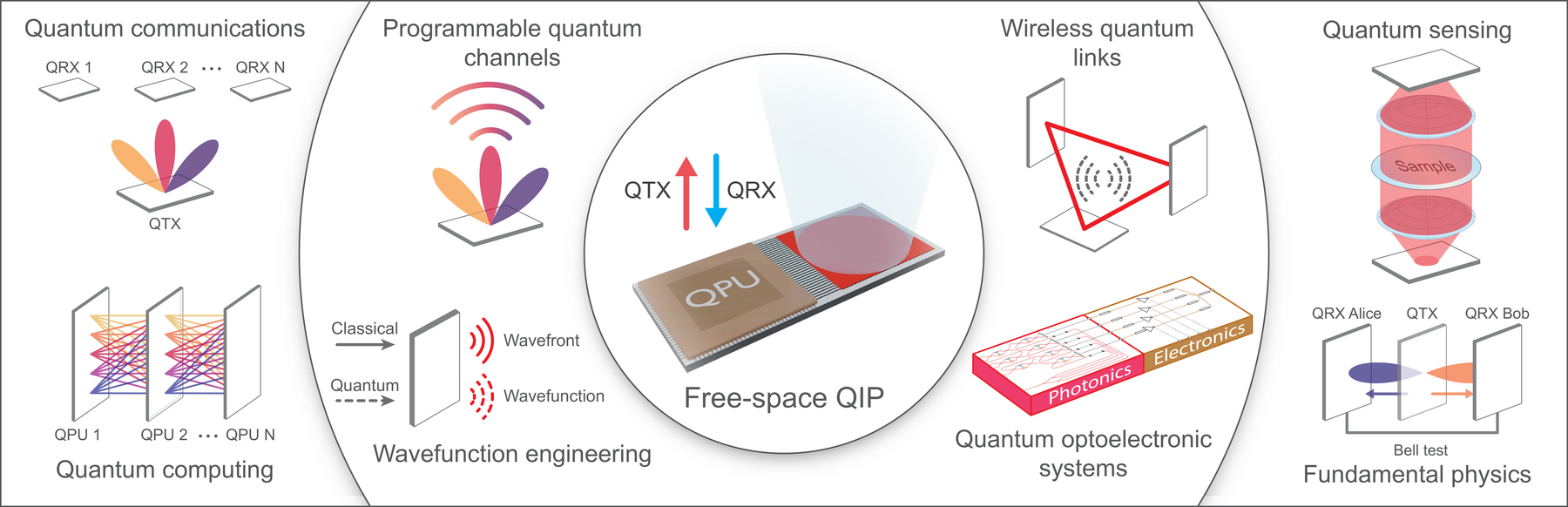
Fundamental physical laws dictate the performance bounds of all technologies. Over the last century, advances in nanotechnology and integrated circuits have driven the performance of computing, communications, and sensing toward these bounds, and classical limits are increasingly constraining further improvements. Quantum technologies open paths to overcoming some of these constraints. My research develops a unified framework for the fundamental limits of information technologies and builds large-scale integrated photonic-electronic systems that approach them. The work spans three domains.
Computing
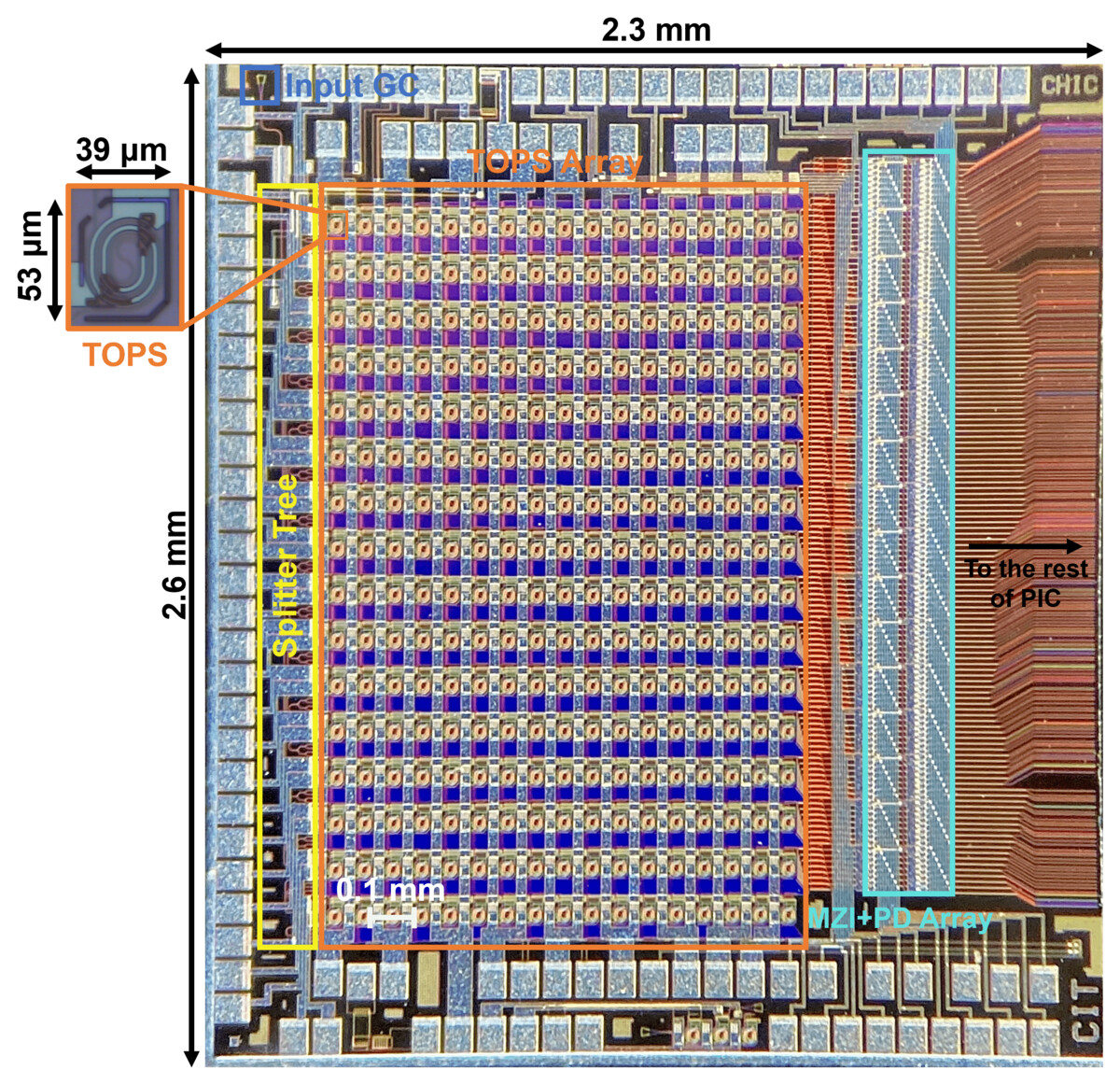
Quantum speed · Bekenstein · LandauerThe speed, memory capacity, and energy efficiency of any information-processing device are bounded by the quantum speed, Bekenstein, and Landauer limits. Current processors operate orders of magnitude away from these bounds, and continued progress requires new computing substrates and architectures. Programmable photonic processors are one such substrate, for both classical and quantum information processing, but their scale has been limited by electrical interconnect density and by thermal crosstalk between phase shifters.
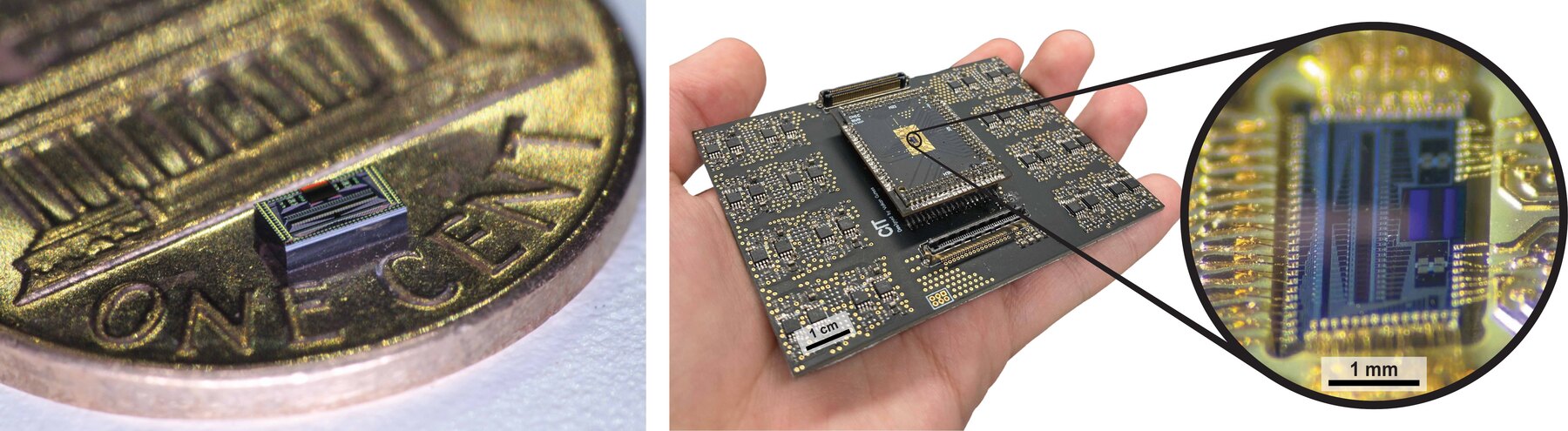
We developed row-column-addressed thermo-optic phase shifter arrays with integrated feedback photodiodes and a thermal model that corrects the crosstalk, and used these arrays to build a reconfigurable photonic mesh with 128 Mach–Zehnder unit cells and 256 phase degrees of freedom. Together with squeezed-light sources and quantum coherent receivers, the mesh forms an optoelectronic processor for measurement-based quantum information processing.
Communications
Shannon · HolevoThe capacity and energy efficiency of any communication link are bounded by the quantum mechanics of the electromagnetic field that carries information through it. For symbol-by-symbol coherent detection, the bound is the Shannon limit; when information is encoded in quantum states and decoded with collective measurements, it is the higher Holevo limit, and the difference between the two is largest at low photon numbers.
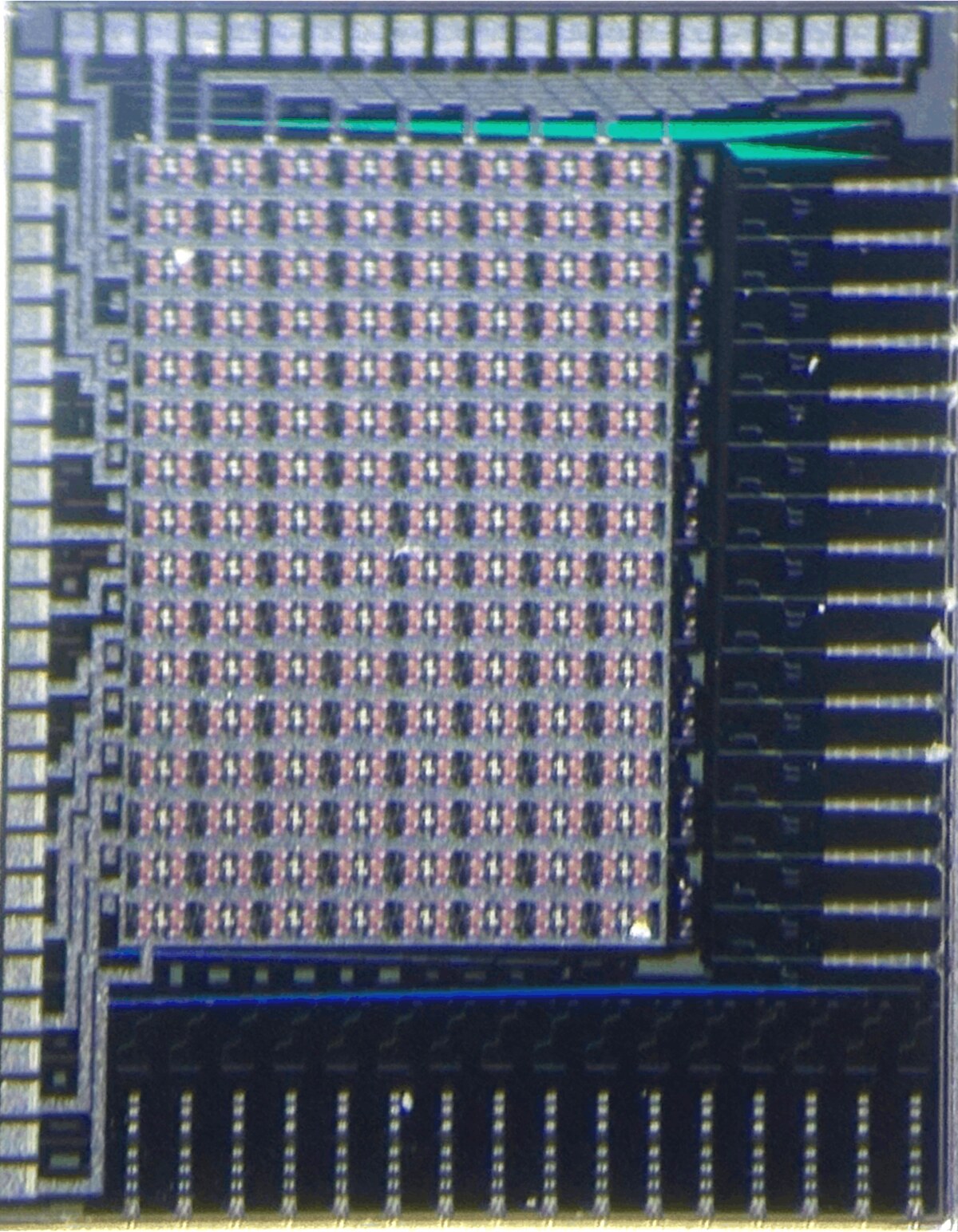
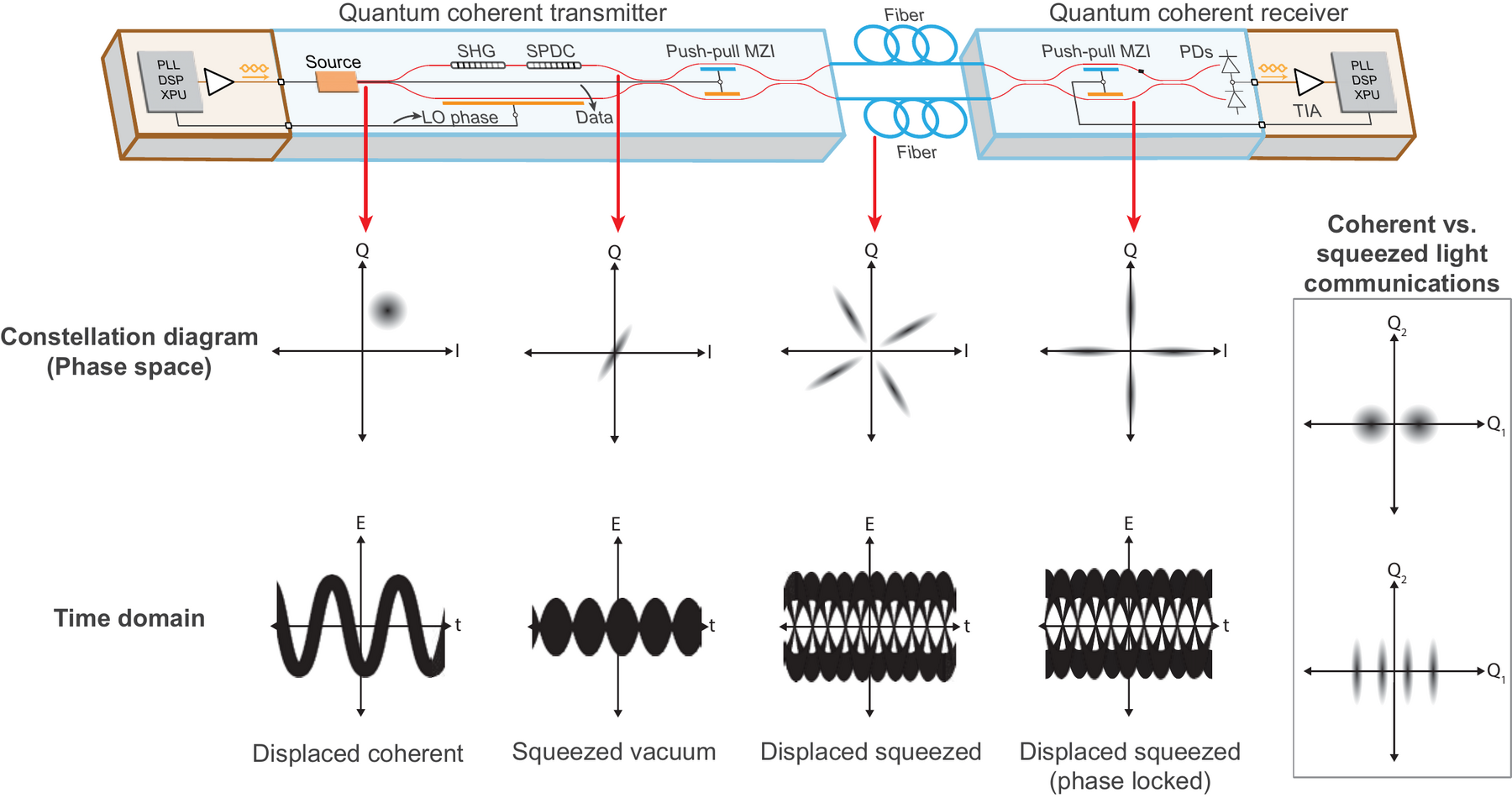
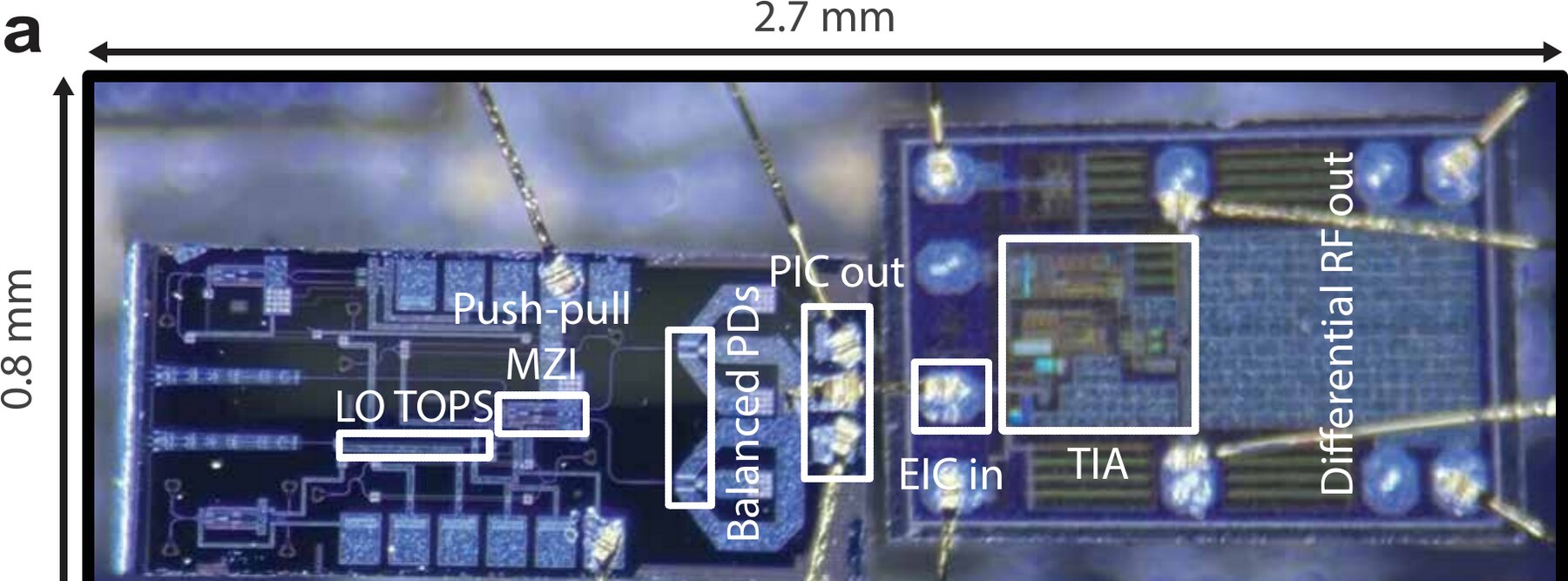
We study this regime and build quantum coherent transceivers that operate in it: integrated photonic-electronic coherent receivers with gigahertz bandwidths and quantum-limited noise performance, scaled to 32-channel arrays, and a squeezed-light communication link that exceeds the one-quadrature Shannon capacity. The same framework is used to evaluate interconnects for high-performance computing against the Shannon, Holevo, and entanglement-assisted capacities.
Sensing
Standard quantum · HeisenbergThe precision of any measurement device is bounded by the quantum mechanics of the probe state and the measurement apparatus. Classical probes are limited by shot noise to the standard quantum limit; non-classical probes such as squeezed light can reach beyond it, toward the Heisenberg limit. In free space, however, loss degrades non-classical states and cannot be compensated by amplification, so quantum-enhanced sensing has largely remained a tabletop experiment.
We introduced quantum phased arrays, coherent antenna arrays that transmit and receive quantum fields over free space, and demonstrated a 32-channel silicon photonic-electronic receiver that performs squeezed-light imaging, beamforming, and beamsteering. The array weights are applied to the local oscillator rather than to the signal, so beamforming adds no loss to the quantum state. These systems enable protocols for free-space quantum sensing, quantum communications, and quantum information processing.